Explore issues facing the United States, with an emphasis on progressive solutions.

Wednesday, September 4, 2019

Is Joe Biden going to save the Democrats in 2020?

What is his compelling message?

Joe Biden, dressed in armor, astride a horse in what looks like medieval England
Is Joe Biden a knight in shining armor?

Joe Biden has been leading by double digits in the polls for the Democratic Presidential nominee since before  he announced his candidacy.  Elizabeth Warren is inching up, but still has a lot of catching up to do.

Oddly, Biden doesn't seem to have a positive reason for running.  Mostly he wants to defeat Trump.  He also doesn't have large, enthusiastic rallies, as some of the other candidates do.

A 9/3/19 article in the New York Times by Mark Leibovich titled "So Why's Joe Biden want this job?  Um, tough one" discusses "the paradox of the leading candidate not having a compelling reason to run.  When asked by a reporter why he wanted to run, Biden responded with "I think it's really, really, really important that Donald Trump not be re-elected.""

If Joe Biden had not been vice-president during Obama's term in office, would he be leading in the polls now?  Is his implied promise to return America to the halcyon days before Trump enough to beat Trump?  Is it even enough for him to get the nomination?

Thinking about the candidates in the most superficial way possible, I could not say what Biden stands for beyond defeating Trump.  Elizabeth Warren wants to stop corruption in Washington D.C., offer Medicare for all, and help people with onerous student loan debt.  Bernie Sanders also wants Medicare for all, a $15 minimum wage, and to help people burdened with college loan debt.

I looked at the websites of the three top candidates.  Biden, by far, has the most detailed and expansive plans for topics ranging from health care to education to criminal justice reform.  No one could accuse him and his team of skimping on the depth and breadth of his positions.  Notably, he doesn't say how he would pay for anything.  And he still doesn't seem to have "that vision thing" (thank you George H.W. Bush).

Biden's website opens with:  "Our Best Days Still Lie Ahead."  The three pillars that support this statement are:  1.  We've got to rebuild the backbone of the country, the Middle Class.
2. We've got to demonstrate respected leadership on the world stage.
3. We've got to make sure our democracy includes everyone.

I cannot seen any reasonable person disagreeing with these statements.  I cannot see, anyone either, being propelled into the streets to support them. 

Elizabeth Warren's website has an urgent sounding headline:  "We will Save our Democracy."  (If we need to save it, it must be in peril - a lot of people are thinking that.)

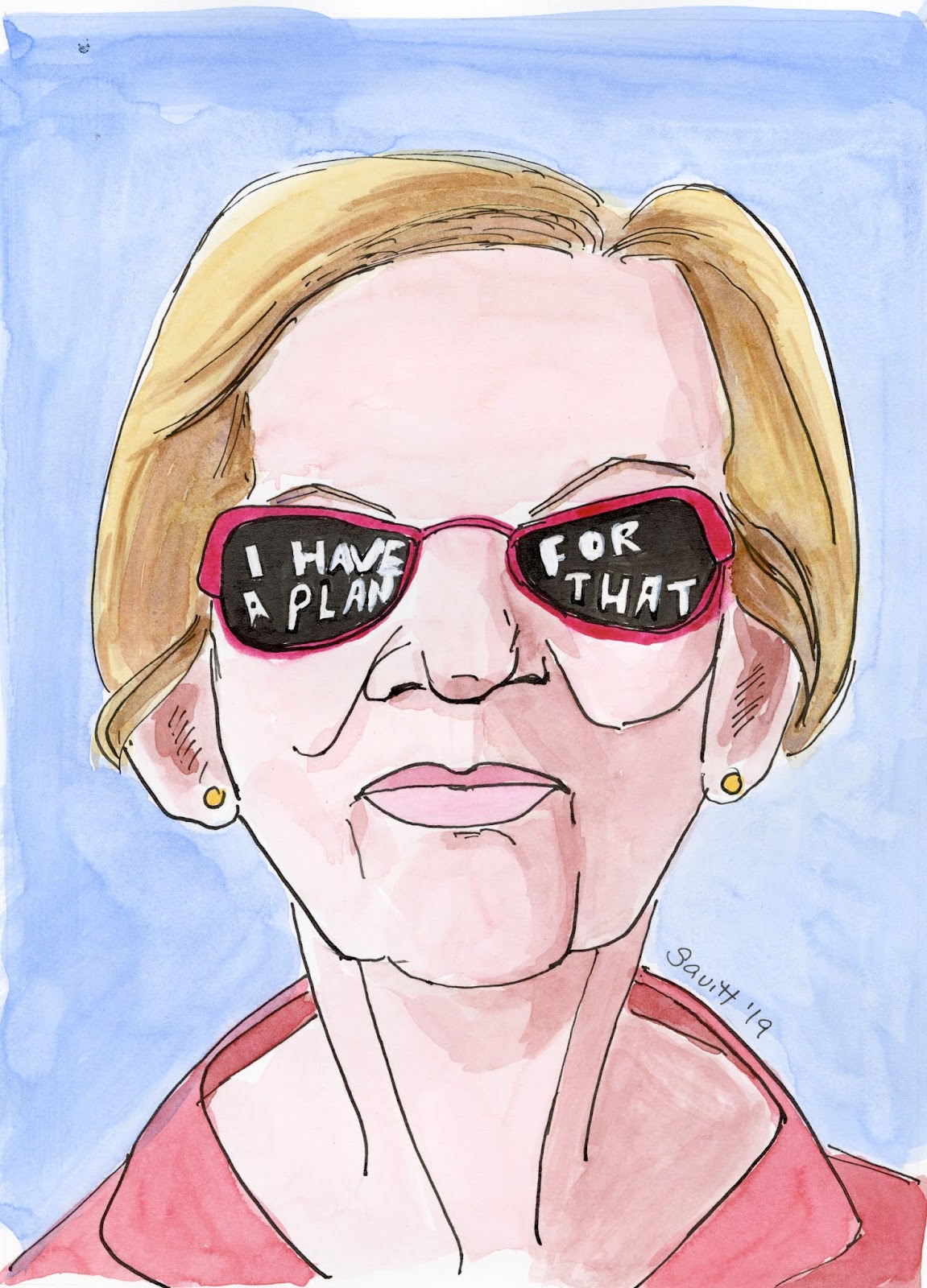
Warren's website, despite her mantra "I have a plan for that" is much less detailed than Biden's.  Unlike Biden, she says how she is going to pay for everything.

What Warren's site lacks in details it makes up for it with arguments that many will find visceral and compelling.  For instance, one of the items on the site is:  "Rebuild the Middle Class", followed by "After decades of largely flat wages and exploding household costs, millions of families can barely breathe.  It's time for big, structural changes to put economic power back in the hands of the American people."

This phrase delivers a punch to the gut (mine, at least).  I didn't experience that on Biden's website.

Ironically, the nerdy, wonky Elizabeth Warren seems to "feel your pain" (thank you, Bill Clinton), more than the touchy, feely Joe Biden.  The next debate may shed light on whether Joe Biden has a different rationale for running for president, and, if it even matters in the long run.

Friday, August 23, 2019

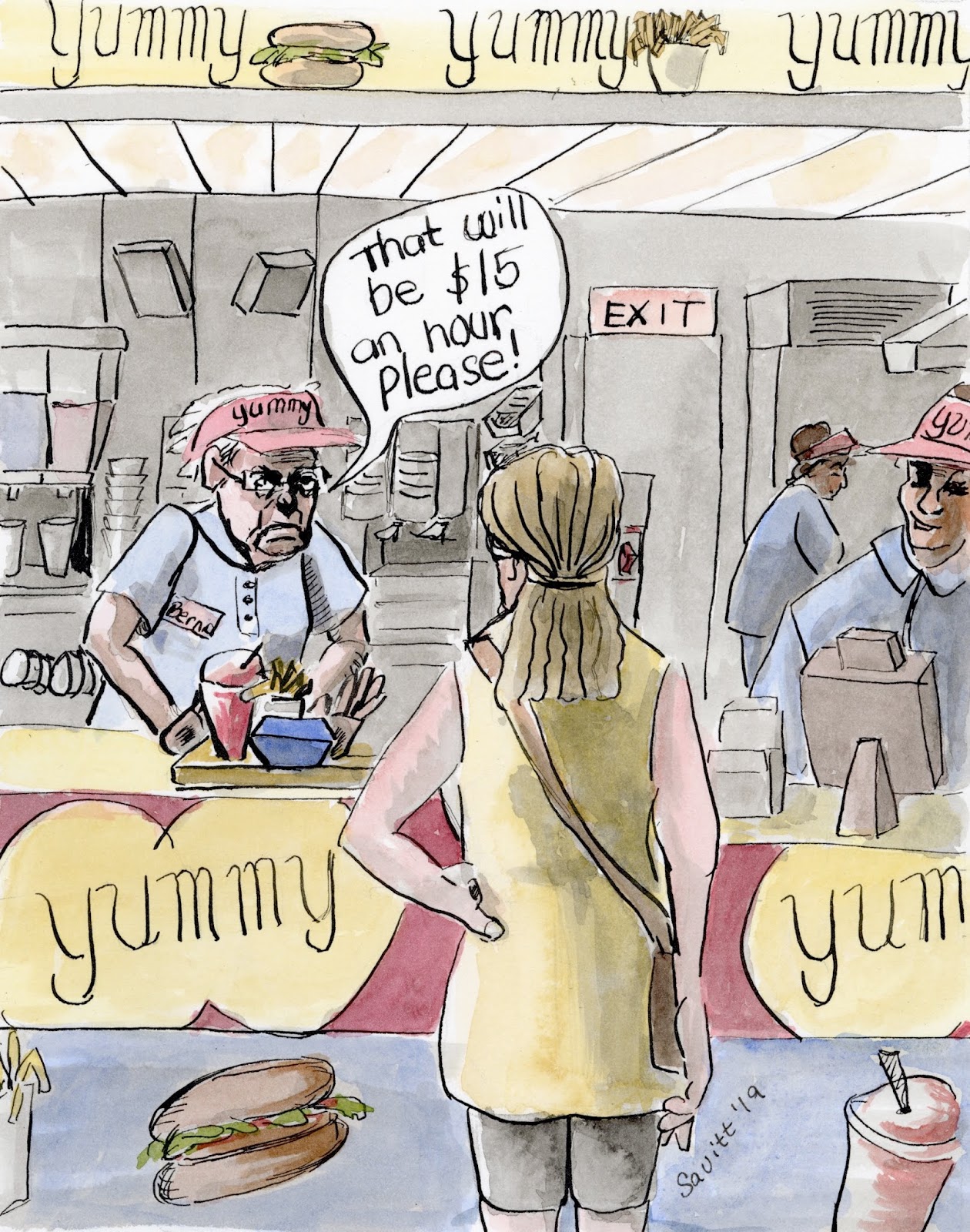
Bernie Sanders wants to raise the Federal minimum wage to $15 an hour by 2024

The pros and cons of raising the minimum wage

Senator Bernie Sanders is seen working in a fast food restaurant, demanding $15 an hour minimum wage as he delivers the food to a customer
Bernie Sanders demands a minimum wage of $15 an hour


The Raise the Wage Act of 2019 was passed by the House on July 18, 2019.  It would phase in raises to the minimum wage to $15 an hour by 2024.  The bill would index future minimum wage increases to median wage growth.  Currently, the minimum wage is $7.25 an hour; it has not been increased since May, 2007.  Senator Mitch McConnell is not likely to take up the bill in the Senate.  (Ironically, Senator Sanders was chided for not paying his campaign workers an effective minimum wage of $15 an hour - largely because his staff were working, on average, 60 hours a week.  This issue has been rectified.)

The biggest question people have about raising the minimum wage is whether or not it would decrease hiring.  Another question is what would the impact be on different parts of the country that have different pay scales.  Where pay scales are lower, workers would benefit enormously; the businesses that hire the workers, though, would experience a pretty drastic increase in wage costs.

Liberal economists, such as those who work for the Economic Policy Institute (EPI), believe that raising the minimum wage would be good for the economy.

In testimony before the US House of Representatives on February 7, 2019, Ben Zipperer, economist for the EPI, stated that a single parent earning the current wage does not earn enough in full time work to rise above the poverty line.  He also state that if the minimum wage had "kept pace with labor productivity growth since 1968, this year it would be more than $20 an hour."

The EPI cites studies that show that raising the minimum wage would not adversely affect employment.  In one study mentioned, they found:  "In their meta-analysis of 739 estimated effects from 37 published studies on the minimum wage and employment between 2000 and 2015, Wolfson and Benjamin (2016) find 'no support for the proposition that the minimum wage has had an important effect on U.S. employment.'"  (From a 2/5/19 report by David Cooper for the Economic Policy Institute titled "Raising the federal minimum wage to $15 by 2024 would lift pay for nearly 40 million workers.")

On the other side, some economists have argued that increasing the minimum wage, especially in areas where the difference between the current and proposed minimum wage is significant, would adversely affects employment.  In a 9/28/18 article by Adam Millsap in Forbes Magazine, he quotes from a study published in the American Economic Review that maintains that increases in the minimum wage reduce employment in the long run.

The studies' authors, Paul Beaudry, David Green and Ben Sand, found that over a ten year period  "that a 1% increase in wages leads to a 0.3% to 1% decrease in employment rate depending on whether wages increase citywide or only in one industry."  The authors found that most of the loss in jobs is  due to firms closing, rather than layoffs.

The minimum wage debate is complex.  The plan Sanders proposes eases the impact on business by phasing in the increases over several years.  What does not seem to be in doubt is that it is difficult to live on a full time minimum wage job.

On an interesting historical note, Otto von Bismarck created the first social security system in the world - to keep the masses from adopting socialism.  You have to ask yourself, if people cannot afford to live on the minimum wage, what will happen to economic growth, and our internal national security, if working class people having little or no disposable income.

Wednesday, August 7, 2019

Is Free Universal Pre-Kindergarten a Prescription for Success?

Some Democrats running for President think so

A politician is encouraging a woman who is pushing a stroller with a small child up a hill
Democratic politicians want to help ease the burden of childcare

Free universal pre-kindergarten for all three and four year olds is being touted aggressively by two men running for president.  Both Bill deBlasio and Julian Castro propose it.  As mayors of New York City and San Antonio, TX, respectively, they have experience with such programs.  Both men initiated them for four year olds - and both have been considered successful.  Other candidates have expressed interest in universal pre-K, but not as forcefully as Castro and deBlasio.  Elizabeth Warren, Kirsten Gillibrand, John Delaney, and Jay Inslee all want it in some form.

A successful pre-K plan has to both help children get ready for kindergarten and help families save money.  Additionally, it should raise the pay of pre-K teachers.

Publicly funded pre-K would ease the financial burden on families with small children.  For example, The Care Index found that the average cost of care for a four year old in Illinois is $10,414 - about 19% of the median household income, and about 61% of income for a single parent earning a minimum wage.  (The U.S. Department of Health and Human Services defines affordable child care as being no more than 10% of a family's income.)  (From a New America article titled "Policy Recommendations:  Universal Pre-K" by Abbie Liederman.)

Some would argue that poor families can avail themselves of the Head Start Program, which is available to families living at or below the poverty line, the homeless, any foster child, or families receiving public assistance.  Head Start, though, does not address the pre-K needs of families living much above the poverty line.

Others look to the Head Start Program to argue agains universal pre-K, stating that the benefits gained during the program fade soon after the children enter kindergarten.  In a study  released on 12/20/17 titled "Head Start Programs have Significant Benefits for Children at the Bottom of the Skill Distribution" by Marianne P. Bitler, UC Davis; Hilary Hoynes, UC Berkeley; and Thurston Domina, UNC, sponsored by The Center for Poverty Research at the University of California, Davis, found that while academic results often fade for most children - those who were in the bottom of the "achievement spectrum" seem to  benefit long-term.   There is also a question of whether the disappearing benefit is the fault of Head Start, or of a failing public school education.   And people are just starting to study the apparent positive impact that emerges when former Head Start students become teenagers.

It will be interesting to see if this issue gains traction as the campaign season progresses.  Families with small children will be happy if it does.


Wednesday, July 31, 2019

The Enthusiasm Gap I see between Elizabeth Warren and Kamala Harris


What my Instagram posts tell me about two of the Democratic candidates for president.

I created five illustrations for a series that I call "Leading Ladies".  I was motivated by a New York


Elizabeth Warren:  "I have a plan for that"


 Times article on the double standard that still forces women to be "likeable" to be elected.

I've posted all five images - of Amy Klobuchar, Nancy Pelosi, the Statue of Liberty, Elizabeth Warren, and Kamala Harris, to my Instagram account.


Kamala Harris promises a fight with Trump


The response has been telling.  Despite the fact that Kamala Harris has more followers than Elizabeth Warren on Instagram (2 million vs. 1.7 million), many fewer people seemed interested in the Kamala Harris illustration than the one of Elizabeth Warren.

A  few groups that support Elizabeth Warren asked for permission to re-post her image.  Once they did, the illustration got quite a few likes, and more requests to re-post.

Despite the fact that the quality is roughly the same for all of the illustrations, and that I specifically used hashtags of artist groups that support Harris, they never liked the post.  In fact, no group supporting her liked the post.  Even Amy Klobuchar's image was liked by her supporters.

My intuition about the enthusiasm gap is just that - intuition.  I don't have enough data points to run a statistical analysis.  Still, I am surprised by the lack of interest from the supporters of Senator Harris.

I "sense", again, I don't "know", that there is an enthusiasm gap between Warren and Harris.  And that gap, if real, is important.

In 2016, my nephew Chris, who lives outside of Cleveland, Ohio (my hometown), told me that he saw many, many more lawn signs supporting Trump than Clinton.  He saw these on the east side of Cleveland, traditionally a liberal part of Ohio.

Again, I don't have enough data to state with conviction that people in Northeast Ohio were more enthusiastic about Trump than Clinton.  Just observation.  And that's where intuition comes from - paying attention to things we see and hear.

Wednesday, July 24, 2019

Elizabeth Warren' Plan to Relieve Student Loan Debt

Will this Plan Fly?
Ellizabeth Warren has a plan to relieve student loan debt
Elizabeth Warren has a plan to relieve student loan debt

One of the key plans candidate for President Elizabeth Warren has is to forgive student loan debt.  On July 23, 2019, she and Representative James E. Clyburn (D - SC) introduced the "Student Loan Debt Relief Act of 2019".  Warren has been talking about this issue on the trail since April of this year.

Reducing the income gap, especially between white Americans and African Americans, is one of the important goals of this legislation.  According to a 7/23/19 article in Forbes.com by Zack Friedman, the plan would cancel student loan debt for more than 95% of borrowers.  Every student with student loan debt in a household making less than $100,000 per year could see up to $50,000 in student loan debt cancelled.  This amount decreases as household income rises.  No one who lives in a household of $250,000 or more would have their debt cancelled.

Warren's plan raises a lot of questions.  Is it fair to families that have been saving diligently to pay for college for many years?  What are the benefits to the country of such a program, which could significantly raise the federal deficit?  And why is higher education in the US so expensive (on average, Americans spend $30,000 a year on college, almost twice as much as the average in other developed countries - Amanda Ripley, The Atlantic, 9/11/18)?

The arguments for such a plan include that even a small reduction in debt would be beneficial, according to the Center for Responsible Lending, a consumer advocacy group.  Their analysis shows that a $10,000 benefit would totally cancel the federal student-loan debt of 61% of the more than seven million borrowers who are in default on their loans (Jill Berman, 7/24/19, Market Watch).

African Americans, with less income to pay for college than other groups, would benefit.  Not only because their incomes are lower, but because they face more prejudice in securing loans.

The question of fairness to families who have saved for college is key.  One response is that preventing bankruptcies because student loan debt is relieved is good for the economy.  If people don't have to spend so many years re-paying their student loans, they could be buying big ticket items like cars and houses sooner, stimulating the economy.

The last question is why is college in the US so expensive?  A plan to relieve student loan debt doesn't address this issue, but it seem like a big part of the problem.

Amanda Ripley explores this issue in the above-mentioned Atlantic article.  A few reasons seem to have driven up costs.  Americans tend to live at college - their counterparts in other developed nations tend to live at home.  This fact means that more money is spent on housing and food services here than elsewhere.

In an effort to balance their budgets, state governments cut funding to public universities and colleges.  These institutions had to compete to attract wealthy students from abroad and out of state.  Marketing expenses rose dramatically.  Private institutions followed suit, because they were losing applicants to public institutions.  There are other reasons, such as the expenses associated with being an institution that does a lot of research.  Generating lots of research makes a college or university more prestigious, but also more expensive, without necessarily benefiting students.

I believe that something has to be done to relieve student loan debt.  I am not sure if Warren's plan is the best, but she does "have a plan for that", and a pretty well thought out one, too.

Tuesday, February 26, 2019

Own it Amy!

By now, you would have had to  have lived under a rock to not know about  Amy Klobuchar's l'affaire de la salade.   Amy, as most of us know, was once so angry and hungry that she ate the salad her aide had gotten for her with a comb because he had forgotten to get  her a fork.

At first, I was horrified.  Then, I found the incident hilarious.


I can relate to being really hungry and foul tempered, to having my food tantalizingly close and yet impossible to eat.  I don't think I would have had the chutzpah to grab my comb and use it as a utensil.  But part of me admires her nerve.

Senator Klobuchar does not seem like the most fun boss to work for.  In her defense, I have been a hated boss myself.  A few years ago one of my employees snapped at me because she was bored.  (I am a voting warden, so I work at most a few days a year.)  Handing out ballots and checking off voters is a boring job.  Everyone knows that.  But this woman expected me to read her mind and do something about her ennui STAT!

I have never yelled at an employee, and I don't recommend that anyone do it.

I do suggest that instead of cowering in fear, if you work for Amy Klobuchar, you tell her to knock it off if she crosses a line.  That goes for everyone who works for anybody.  Your boss is human, too, and may well need to be told to behave from time to time.

Wednesday, February 20, 2019

Not "Likeable" Enough? Too Bad!

I told my daughters on election night 2016 that they would remember the next four years as terrible times, but also, perhaps, as the most exciting times of their lives.  True to my word, the last two plus years have been exciting - full of energy, enthusiasm and creativity.

One of the great developments has been the surge of woman candidates running for office at all levels.  Several are running for president.

As day follows night, though, we see the re-emergence of the trope that women need to be "likeable" to be elected president.  Amy Klobuchar, in particular, has been singled out.  People report that she is a "bad" boss who scares off staff, yells at people, and "throws things".

Amy Klobuchar wearing sunglasses that say "Bad Ass" - she doesn't care about likeablilty

Though I am not a fan of yelling bosses, my experience with one taught me that not everything is as it appears.  I worked for a woman named Sharyn in the early 1980's in the credit and collections department of a Fortune 500 high tech firm.  When Sharyn found out during my first interview that I was from Ohio, she asked me if I was "square".  My future co-workers warned me about her with advice like "don't cross her", and "be ready for insults".

Sharyn was, indeed, a tough boss.  She was profane, loud and obnoxious.  When she didn't like an idea, no matter whose idea it was, she would often say "You can dress up a bloody corpse and put it in a tuxedo, but it is still a bloody corpse."  She was also charismatic, funny, smart and good at her job.

After I had spent a year doing credit analyses for big contracts, Sharyn promoted me to Supervisor of Accounts Receivables.  Delia, a young woman of Portugese descent, worked for me.  One day, Sharyn make fun of Delia's Portugese background, calling her "Portugee".  I was horrified, Delia was mortified, the rest of the people in the area were embarrassed, and Sharyn was clueless.

Later, Delia told me how upset she was.  "I'll take care of it" I said.  I felt like Dorothy approaching the Wizard of Oz as I walked into Sharyn's office.  "You have to apologize to Delia for the Portugee comment.  She is really upset."

Sharyn got up from her desk to find Delia.  She apologized sincerely, on the spot.  This terrifying woman had enough sense or humility, or both, to make amends immediately.

Sharyn didn't change, though.  She wouldn't change, even after another incident, more serious than anything I had ever experienced.

Cynthia, Sharyn's secretary, started dating John, a co-worker.  After a while they moved in together.  One day, Cynthia came in to work with a black eye, a swollen lip, and bruises on both arms.  When Sharyn asked what happened, she said "John beat me up."

When confronted, John appeared shocked and insulted.  "She beat me up!"  Yet John had no black eye or bruises.  He didn't look cowed and afraid, as Cynthia had.

Sharyn took up the issue with Vic, her boss, with whom she had an adversarial relationship.  Sharyn's
modus operandi was to try to intimidate everyone, including her boss and peers.  Vic had several departments under him, and was not happy to have to deal with Sharyn.  He respected her results, though, and I believe he respected her, too.

Vic interviewed John and Cynthia separately, then fired John and had him escorted out of the building, warning John never to approach Cynthia again, "or else".

Although I was really shaken to see evidence of domestic violence, I was glad  that everyone went to bat for Cynthia.  I think that Sharyn's relentless nature, her advocating for women, and her stubborn refusal to walk away from a fight, created an environment that led Vic to fire John,

Sharyn was both a good boss and a tough boss.  A bad boss is one who blocks your advancement, offers no guidance or support, and sabotages you.  It doesn't matter how "likeable" they are if they aren't on your side.

I don't work for Amy Klobuchar.  I don't know if she is a good boss or a bad one.  But I don't assume that someone is a bad boss because they yell at people, or a good boss because they smile and are likeable.